
Where TCADC Releases Go
Taos County Adult Detention Center is the county adult jail, not a New Mexico Corrections Department prison. A person may leave TCADC after bond, dismissal, time served, sentence completion, or another court-authorized disposition. Those events can result in release to the community. Leaving the building can also mean transport to an NMCD prison, another county jail, an overflow placement, a federal custodian, ICE, a hospital, or another institution. That second group is a custody movement, not community release.
The destination is the key fact. County detention job descriptions describe transport between the jail, courts, prisons, and other points, as well as overflow contracts. A statement that a person is “not here” establishes only that TCADC is no longer the current location. Ask whether the release/out-processing record lists a physical release and whether the custody-movement record names a receiving agency. The full Taos County released-inmate search and records path is available on the home page.
Confirm a TCADC Release
No official Taos County public jail roster, 24-hour release list, 72-hour release list, or release archive was located in the reviewed county navigation as of July 29, 2026. Confirmation therefore starts with a named inquiry rather than a feed. Use enough identifying detail to avoid confusing two people with similar names.
- Call TCADC Booking at (575) 737-3801. Ask whether the named person remains at TCADC and whether staff can state a release date or transfer destination.
- Check the New Mexico court docket for a bond action, dismissal, sentence, or release-related order. Obtain the actual order from the court clerk if the docket entry is unclear.
- Submit a written Taos County request for the booking, custody movements, release/out-processing record, physical release date and time, and disposition or destination.
- If the record names NMCD, BOP, USMS, ICE, or another jail, continue with that receiving system. Do not label the movement as a community release.
The proof sources answer different questions. A court file shows legal authorization. TCADC records show when county physical custody ended. A receiving agency’s locator can show where custody continued. When sources disagree, rely on the final custodian for physical release time and the court for the legal reason.
Identity checks matter at each step. Use a date of birth, booking number, NMCD offender number, BOP register number, or ICE A-number when one is lawfully available. Note the exact spelling, system, date searched, displayed update time, and response. That simple log helps distinguish a delayed update from a later arrest or from two people who share a name. It also makes clear which conclusion came from a record and which remains an inference.
TCADC Release Record Contacts
Booking handles the immediate facility inquiry. A written Inspection of Public Records Act request creates the stronger route for the underlying release and movement documents. Taos County accepts requests through its NextRequest portal, as well as by email, mail, fax, or delivery to the records custodian. Written requests receive the Act’s procedures and remedies; an oral question does not have that same status.
Taos County Adult Detention Center
105 Albright Street, Suite O
Taos, NM 87571
Booking: (575) 737-3801
Director: (575) 737-3800
Taos County Records Custodian
Anna Martinez, Chief Deputy Clerk
105 Albright Street, Suite D
Taos, NM 87571
(575) 737-6380 · Fax (575) 737-6390
anna.martinez@taoscounty.org
Give the requester’s name, address, and telephone number. Describe the person and booking with a date range, date of birth, or booking number. Ask for electronic copies when practical. The county need not create a new document, and protected or expunged material may be withheld or redacted.
TCADC Release Record Fields
Taos County has not published a fixed release-report field dictionary. Its personnel materials do establish that staff update resident files in the Sleuth system, process release documents, secure formal signatures, maintain court papers, and handle booking and release paperwork. The useful response is a set of existing records, not an answer created for the request.
| Requested record or field | What it can establish |
|---|---|
| Booking number and admission date | Connects the person to the correct detention episode. |
| Custody-movement history | Shows transfers and possible receiving custodians. |
| Release/out-processing record | Shows whether TCADC completed physical release processing. |
| Release date and time | Identifies when county custody ended, if recorded and releasable. |
| Disposition or destination | Distinguishes community release from continued custody elsewhere. |
| Release authority and signatures | Connects the event to an order and completed processing. |
These are request categories, not guaranteed public fields. If an older record cannot be found, ask which retention schedule applies. The county did not publish a special TCADC release-record fee, so use the custodian’s estimate and county Resolution 2022-11 rather than assuming another agency’s charge.
A booking photograph may be requested separately, but it proves intake rather than release. New Mexico expungement law can restrict qualifying arrest, booking, photograph, court, corrections, and discharge entries. A blank response may therefore reflect retention, a lawful restriction, or the lack of a matching record. It is not proof that the booking never occurred. Medical, juvenile, security-sensitive, sealed, and other protected material may also be redacted or withheld.
TCADC Complex Record Context
The current county facility page says TCADC opened June 26, 2011, houses male and female detainees, and has 88 beds. The historical Administration/Judicial Complex page describes a move during May 14–16, 2011 after a 20-month construction project. It lists 84 adult spaces and 18 juvenile spaces, with a published project cost of $46 million.
The official TCADC source also shows the local facility context and its direct public-record route.
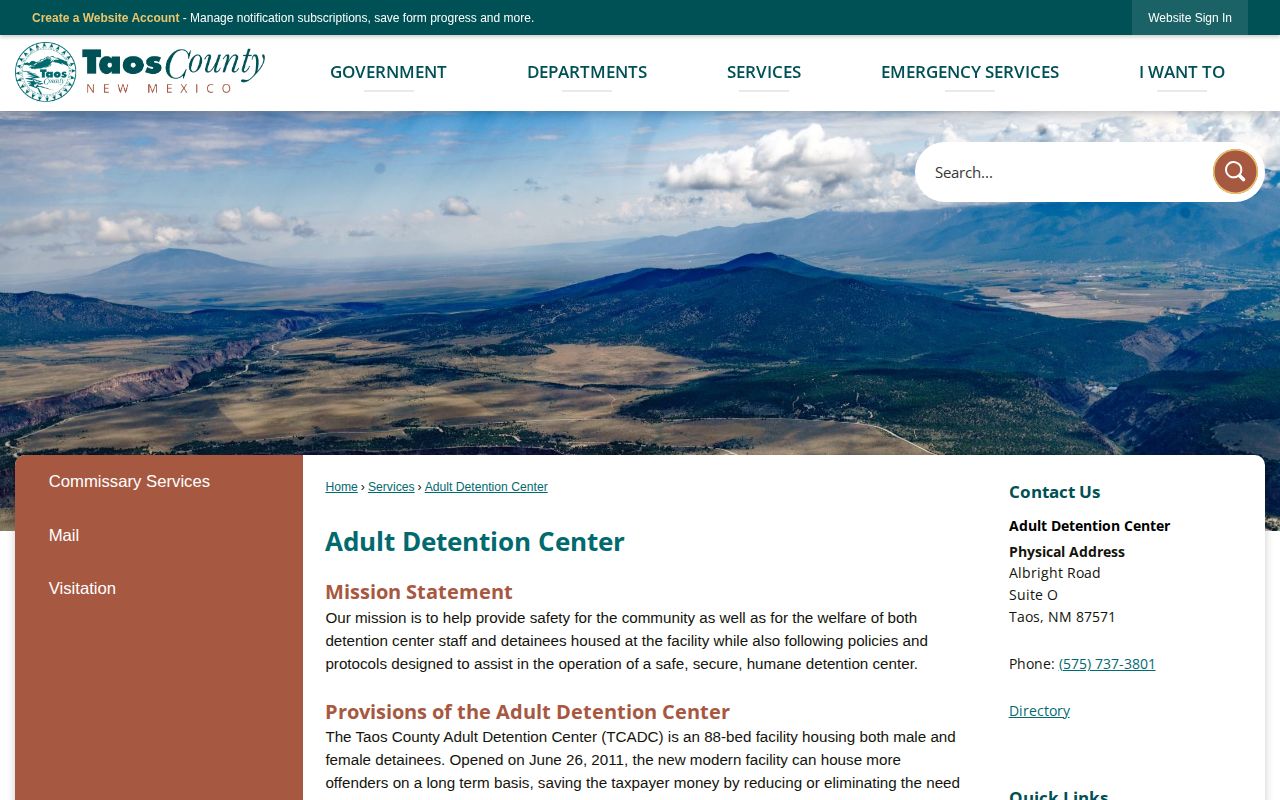
The county page supports the current 88-bed figure and helps route a named release-record request without implying that it hosts a public release feed.
The figures come from different county contexts and should remain separate. The complex is not a second jail. Its north wing contains adult detention, the east wing houses court functions, and the south wing contains administration. Juvenile space is not an adult released-inmate pathway, and juvenile records have distinct access limits.
The shared site explains why a court order and jail out-processing may occur close together, but they remain separate records. District Court is associated with Suite N, Magistrate Court with Suite M, adult detention with Suite O, and county records with Suite D.
That layout makes an in-person comparison practical. District Court handles felony matters. Magistrate Court handles misdemeanors, DWI and traffic matters, and felony preliminary proceedings. A docket may show bond, dismissal, sentence, or another disposition, while the detention record supplies the physical release time. Public Case Lookup gives docket information, not every underlying document, so an unclear order should be obtained from the correct clerk.
Mail After a TCADC Release
TCADC’s published mail rule gives one concrete after-release effect. Mail addressed to a person who has been released is not forwarded. The facility returns it to the sender or handles it through dead-letter procedures. That policy protects against treating the jail as a forwarding address after custody ends.
Mail is not a release test. A returned letter may reflect release, transfer, an addressing issue, or another operational reason. Confirm status through Booking and the release or custody-movement record. When contact is the goal, obtain a current address directly from the person or another authorized source.
Note: The mail policy describes handling after release, but it does not replace a dated out-processing record or destination entry.
TCADC Transfer Release Checks
A movement from TCADC to state prison may not appear in NMCD data at once. NMCD says adult prison information updates nightly and asks users to allow 24 hours for new data. Search by name or offender number, and use “Include Inactive” only when checking a later completed or discharged state record. NMCD has no jurisdiction over people held only in county custody.
Federal and immigration routes are narrower. A federal pretrial defendant may remain under USMS authority in a local contract facility, and USMS has no public released-person locator. A sentenced federal prisoner may later appear in BOP records. An ICE transfer should be checked promptly in the Online Detainee Locator, which includes certain people released from ICE custody during the prior 60 days. None of those system checks alone proves the original TCADC release destination without the county movement record.
Use the receiving agency’s identifier and access date when preserving the result. That detail keeps a later status change from rewriting what the earlier custody record showed.