
Where Taos Federal Releases Go
Federal custody is a system pathway, not a named Taos County facility. The U.S. Marshals Service manages federal pretrial custody from remand through acquittal or release, or through conviction and delivery to the Federal Bureau of Prisons. USMS can use federal, state, local, private, or contract detention space. A person under federal authority may therefore be physically held in a jail that does not look like a federal prison.
A pretrial defendant may leave a holding facility under a federal court order, move to another contract jail, or transfer to BOP after sentencing. A sentenced prisoner may later leave BOP custody on a completed or projected date, then enter supervised release or another jurisdiction’s custody. “Released” in the BOP location field means no longer in BOP custody. It does not resolve supervised release, ICE detention, or a state or local hold.
| Federal stage | Best release evidence |
|---|---|
| USMS pretrial detention | Federal docket and release order, plus holding-facility out-processing confirmation. |
| USMS transfer after conviction | Docket, movement confirmation, then BOP search when intake posts. |
| Sentenced BOP custody | BOP Inmate Locator result and release date. |
| Older or detailed federal record | BOP FOIA, or National Archives for pre-1982 records. |
Confirm a Taos Federal Release
Begin with the case stage. USMS has no public released-inmate locator comparable to BOP’s tool. Its policy also declines public release of prisoner histories, photographs, and arrival or departure times. A pretrial search must therefore combine the federal docket with the actual holding custodian.
- Check the federal docket for remand, release, acquittal, sentencing, or commitment orders. Read the actual order when the docket text is brief.
- Identify the physical holding facility. Ask whether out-processing occurred, while recognizing that staff may restrict details.
- If the person was sentenced to federal prison, open the BOP Inmate Locator and search by register number or name.
- Read the location and release date together. A past date with location “RELEASED” confirms only that BOP custody ended.
- Use BOP FOIA for additional releasable records. For confinement ending before 1982, follow the BOP route to the National Archives.
A TCADC record remains relevant when federal custody began with a local hold or transfer. Request the county custody-movement and destination entry. That record can prevent a federal transfer from being mistaken for release into the Taos community.
Keep a dated search log. Record the person’s full and middle names, known federal number, approximate age, case number, locator date, displayed release date, and location. When a docket order predates a facility response, the difference may be ordinary out-processing time. When a BOP result appears after a local jail departure, the interval may reflect transport and federal intake. The sequence is clearer when each agency’s event is preserved rather than merged into one “release” date.
Federal Release Record Routes
The BOP Inmate Locator is the public route for sentenced federal prisoners from 1982 forward, including released results. It accepts a BOP register number or a name search. Optional age, race, and sex fields can help distinguish close matches. The separate BOP FOIA process is the record-request fallback.
Federal Bureau of Prisons
Public route: BOP Inmate Locator
Record route: BOP FOIA
Coverage: federal prison records from 1982 forward
U.S. Marshals Service
Custody role: federal pretrial prisoners and transfer to BOP
Public released-person locator: none located
The federal docket identifies judicial authority but may not show the exact time a contract facility completed release. The facility answers the physical-custody question. BOP answers only its own prison system. These sources should be reconciled instead of treated as substitutes.
A federal record request should be narrow enough to locate the named file. Supply the register number when known, the full name, date of birth or approximate age, and the relevant prison dates. BOP directs pre-1982 inquiries toward the National Archives because the public locator begins with 1982 records. A record may still be limited by federal disclosure rules, and USMS policy specifically restricts public prisoner histories, photographs, and arrival or departure times.
BOP Release Search Fields
The BOP locator offers two main search modes. A number search is usually the cleaner route when the federal register number is known. A name search can be narrowed with personal descriptors, but every result still needs an identity check.
| Field | Release use |
|---|---|
| Register number | Search in the federal #####-### format. |
| Name | Search a sentenced federal person when no number is known. |
| Age, race, sex | Optional match controls for common names. |
| Release date | A past date may be actual; a future date is projected and can change. |
| Location | “RELEASED” means the person is no longer held by BOP. |
An “UNKNOWN” release date means the term is not yet determined. First Step Act calculations can affect a future date. A BOP record does not cover a federal pretrial defendant who never entered BOP, and it is not a universal custody record.
A past date paired with “RELEASED” is strong system-specific proof that BOP custody ended. A future date is a projection and can move. Neither result says whether a term of supervised release remains. It also does not rule out ICE or another jurisdiction. Use the federal court record for the sentence and later court action, and use the next custodian’s record when the person was transferred at the prison gate.
Read Federal Release Results
The official BOP locator explanation defines its historical coverage and explains how to interpret a released location and date.
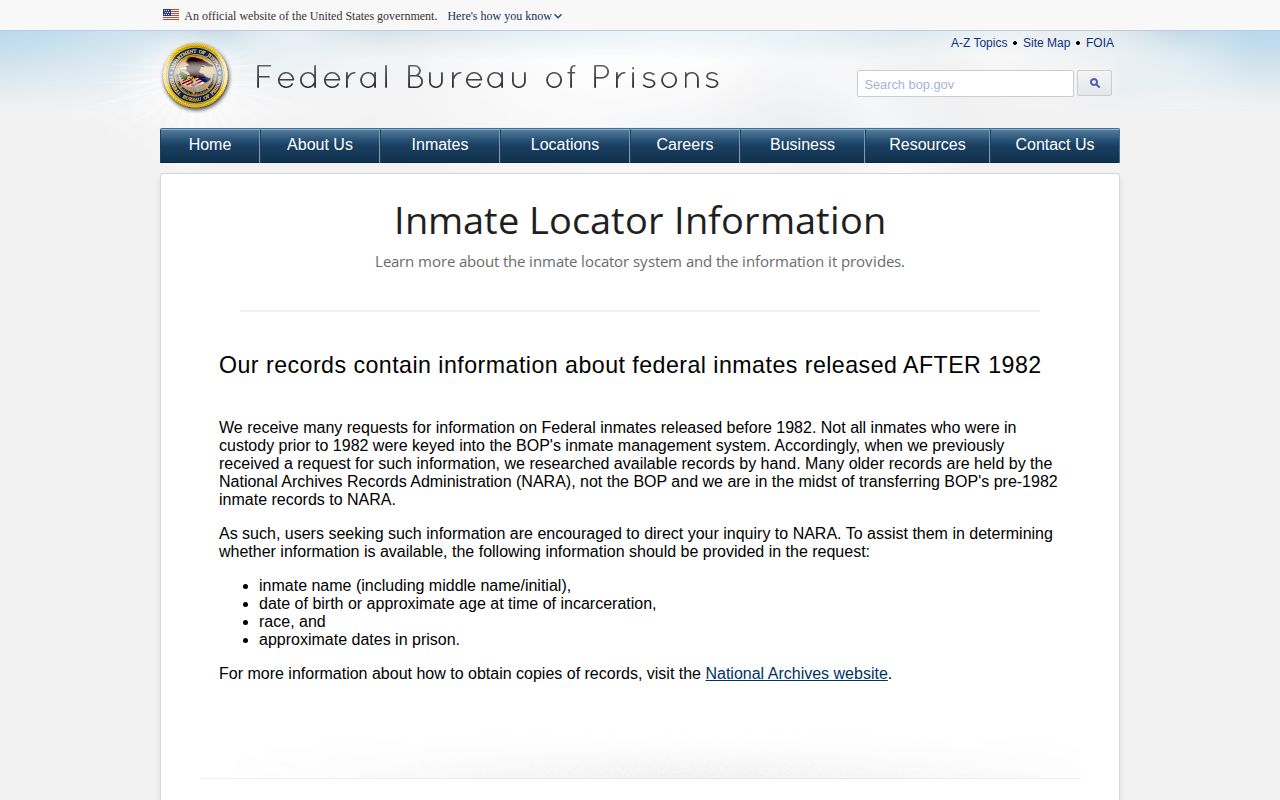
The result establishes the end of BOP custody on the displayed system date, not the end of every court condition or another agency’s custody.
Names alone can produce weak matches. The register number, age, race, and sex fields shown in the result help distinguish people, but they should be compared carefully and respectfully. Do not force a match when identifiers conflict. A no-result search may reflect a spelling issue, pre-1982 confinement, pretrial-only USMS custody, or a person who was never committed to BOP.
USMS Release Has No Locator
USMS custody is often the gap in a federal release search. The agency can hold a pretrial defendant in a contract jail, but it does not publish the same released-person search that BOP maintains. A missing local jail entry is not enough because USMS may have moved the person to another holding location.
The strongest pretrial package contains the federal release order, a holding-facility confirmation that physical out-processing occurred, and any available local custody-movement entry. After a conviction, the docket may show commitment to federal prison before a BOP result appears. Record the dates of each source so a transfer lag is not mistaken for a conflict.
For a defendant acquitted or released before sentencing, BOP may have no record at all. The docket should identify the judicial event, and the contract holding facility controls the physical departure record. If the person moved from TCADC under a federal writ or hold, Taos County can supply its own movement record even when federal policy limits the later location detail.
ICE Holds After Federal Release
Federal prison release can be followed by immigration custody. ICE’s Online Detainee Locator covers current detainees and people released from ICE custody within the prior 60 days. That short window makes it a prompt secondary check when a BOP result says released but another fact points to an immigration hold.
The Albuquerque ICE check-in office lists Taos County in its service area. This regional connection does not create an ICE detention center in Taos County, and it does not turn the office into a general federal release-record custodian. Use the named record and identifier, then separate the BOP end date from any later ICE event.
For county-origin cases, the broader Taos County release search explains how local movement records, court records, and receiving-system results fit together. Each agency can confirm only the custody it controlled.
No BOP prison or dedicated USMS detention facility was established in Taos County by the reviewed sources. A Taos connection may arise from residence, arrest, a local contract hold, or an underlying case, while the actual federal confinement occurs elsewhere. Identify the custodian from the docket and movement records instead of choosing a facility based on geography.
The official TCADC page identifies the county custodian, while Taos County’s records instructions define the written request. Submit a narrow movement request through the county portal when a federal handoff followed local detention. The county can document its own custody endpoint even when federal disclosure rules limit later details.