
Taos County Projected Versus Actual Release
NMCD uses the exact term Projected Release Date, often shortened to PRD. It is an estimate based on the sentence, credit already earned, and credit expected to be earned. It is not the same as the day and time a person actually leaves a facility. The actual event depends on a completed release process and any other legal custody. A person may also leave prison on parole and remain under supervision.
A Taos County Adult Detention Center detainee presents a different question. Someone awaiting trial has no settled sentence from which to calculate a date. Bond, dismissal, a plea, time served, a new order, or a transfer can change the custody path. A person serving a county-jail sentence may have a calculation, but no Taos-specific good-time policy or weekend-release rule was found. Ask Booking for the custodian’s calculation and obtain the sentencing order rather than importing NMCD prison rules.
Transfer is another key limit. Leaving TCADC for NMCD, another jail, the U.S. Marshals Service, or ICE is not community release. The receiving system becomes the source for a later date.
Find a Taos County Projected Date
Identify the present custodian before searching. NMCD’s public tool concerns state prisoners and people on state probation or parole. The agency states that it has no jurisdiction over county or city detention facilities. Its public detail view was not verified through reCAPTCHA during the research, so a PRD must not be promised as a field on every public result. NMCD does maintain the date internally, and Offender Management Services is responsible for its calculation.
- For TCADC, call Booking at (575) 737-3801 and ask whether the person is still present, released, or transferred.
- Check the New Mexico court docket and obtain the sentencing or release order from the responsible clerk.
- For a state prisoner, open the NMCD Offender Search and search by name or offender number. Match identifiers carefully.
- Use Include Inactive if the person may already be discharged. Allow for NMCD’s nightly prison-data update.
- Ask the named institution or appropriate NMCD channel to verify the current date. Eligible callers may use Victim Services for release-date information.
- For a county sentence, request the jail’s calculation and the court order. Do not apply the state-prison deduction formula yourself.
NMCD directs users away from Central Office, Constituent Services, and the Records Bureau for routine release updates. Use the online search, the institution or P&P office, and Victim Services where appropriate. Inmate Records/OMS can be reached at (505) 690-9790 for records-related routing, while search assistance numbers are (505) 827-8710 and (505) 231-4762.
The full county release-record route, including the written records request, appears on the Taos County released-inmate lookup. That route is more reliable than trying to turn a current roster absence into a date.
New Mexico Release-Date Calculation
NMCD Offender Management Services starts with the judgment and sentence. It accounts for credited presentence confinement and the effect of concurrent or consecutive terms. Concurrent terms run at the same time; consecutive terms run one after another. OMS then posts earned or forfeited deductions under the governing law and NMCD policy. The result is the current PRD, not a personal estimate.
The safe model is: judicial term minus credited presentence confinement, minus posted monthly and lump-sum deductions, plus forfeited time, restored credit, and later court or audit corrections, equals the current PRD. Offense class, conviction date, multiple cases, parole revocation, and institutional records all matter. The formula explains the inputs but cannot reproduce an individual calculation without the official file.
The official OMS page identifies the bureau that calculates release dates and maintains the state prison record.

The state source confirms who owns the calculation. It does not convert a projected date into a guarantee of release.
Taos County Earned-Time Rules
NMSA 1978 §33-2-34 governs earned meritorious deductions for New Mexico prisoners. After presentence confinement is credited, deductions apply against the remaining sentence. The statute caps credit for a serious violent offense at four days per month and allows up to 30 days per month for a nonviolent offense. A failure to take part in approved programming may cause loss of credits. After parole revocation, the rate follows the applicable offense class.
Qualifying lump-sum awards also exist. The statute includes 30 days for certain approved vocational, substance-use, or mental-health programs, 90 days for a high-school-equivalency credential with a separate disability provision, 120 days for an associate degree, and 150 days for a bachelor or graduate qualification. Eligibility and limits apply. Life and life-without-release or parole sentences do not receive earned deductions.
Expected credit and posted credit must also be kept apart. NMCD’s family material describes PRD as using time earned and time expected to be earned. That means a future date can assume continued participation or conduct that has not occurred yet. A person who later misses approved programming may not earn the expected amount. Credit can also be forfeited, restored, or supplemented by a qualifying award. The official ledger, not a family calculation based on the maximum monthly rate, shows what NMCD has actually applied. Presentence confinement belongs in the calculation too, but the sentencing record and OMS file must agree on the credited period.
New Mexico does not have a literal law requiring every serious violent offender to serve exactly 85 percent. The four-day monthly ceiling is sometimes called an “85% rule,” but the New Mexico Supreme Court explained in State v. Rudolfo that the range is roughly 86.85 to 100 percent and a court cannot simply order “85%” under the Act. Use the actual statutory rate.
The published earned-deduction statute is captured below as the controlling source for those monthly limits.
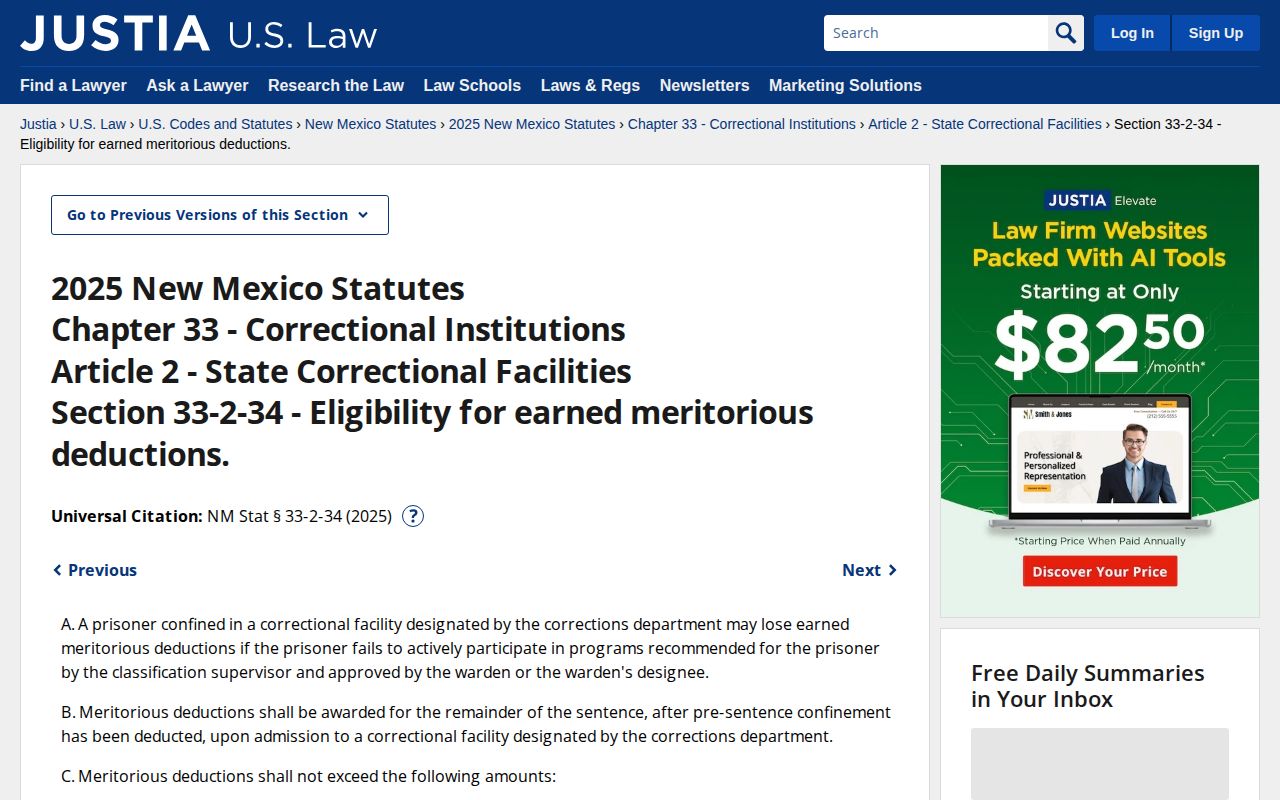
The law supplies categories and limits. Only NMCD can apply them to the complete sentence and credit record.
Why Taos County Release Dates Move
A PRD moves when the facts used in the calculation change. Some changes come from conduct and programs inside the prison. Others come from a court, a second sentence, an audit, or another agency’s hold. A parole decision can affect when physical release occurs without erasing the underlying prison calculation. The most recent official record controls.
| Factor | Possible effect | Best source |
|---|---|---|
| Earned monthly credit | Moves the projection earlier when posted | OMS credit record |
| Misconduct or missed program | Forfeits expected or earned credit | Institution and OMS record |
| Restored or lump-sum credit | May move the date earlier if eligible | NMCD decision and PRD record |
| Amended judgment | Changes the legal term or sentence structure | Court order and OMS recalculation |
| Detainer or other hold | May prevent community release or cause transfer | Holding agency and movement record |
| Parole grant or denial | Affects supervised release timing | Adult Parole Board order |
| Audit correction | Moves the PRD when data or math is corrected | OMS calculation |
A missing public search record is not a factor in the calculation. NMCD warns that technical problems can hide a record temporarily. Likewise, release from one facility may be only a transfer. Confirm the destination before telling family that the person is free in the community.
County-sentence calculations need a separate check. TCADC and the courts occupy neighboring parts of the Albright Street complex, but their records are not interchangeable. The sentencing order supplies the legal term, credited time, and any later amendment. Detention records show the facility’s computation, custody movements, and eventual out-processing. If the two appear inconsistent, request both records and ask the responsible custodian to explain its own entry. No source located for Taos County publishes a standard release hour, a rule that moves every weekend release, or a local earned-time rate. Applying an NMCD prison rate to a county sentence could produce a false date. The county also need not create a calculation that was never recorded. A precise written request should identify the person, booking number or date range, sentence order, calculation sheet, credited days, release authority, destination, and actual release time if it has occurred.
Note: NMCD prison data update nightly, so allow the agency’s requested 24 hours before treating a newly posted change as missing.
Confirm a Taos County Release
Verification should pair an estimate with an event record. For a state prisoner, compare the NMCD search, the latest PRD held by OMS, and any Adult Parole Board order. For a county detainee, compare the court order with TCADC’s physical release or custody-movement record. The court can authorize release, but detention staff document out-processing. Each answers a different part of the question.
New Mexico VINE can send a pending custody-change alert by phone, text, or email. It is useful for notice, not as the sole proof. NMCD expressly warns users not to depend only on VINE. Registration may need to be renewed after a move between county jails or from a jail to NMCD. Detailed registration steps and the current service caveat are on the VINELink Check.
Eligible callers may contact NMCD Victim Services at (877) 842-8464 during its published weekday Mountain Time hours for release-date questions. Automated VINE registration is separate from written parole-hearing and release notice arranged through the prosecuting district attorney. A person seeking a formal historical record should request the order or calculation from the office that maintains it.
Parole eligibility is another date that can be confused with PRD. An eligibility date marks when the Board may consider a person under the governing sentence. It does not show that parole was granted or that release processing is complete. The Board may grant, deny, revoke, or ultimately discharge supervision. Its written order is the source for the result. If parole is granted, an approved plan and accepted conditions may still affect physical release. If parole is revoked, the earned-deduction rate follows the applicable offense classification, and OMS may update the prison projection. These steps explain why a court date, Board date, and prison date can all be accurate while answering different questions.
For federal or immigration custody, stop using the NMCD path. The BOP locator gives federal release-date information for sentenced federal prisoners, while ICE’s locator has a limited recent-release window. A TCADC movement record naming USMS or ICE is evidence of transfer, not a New Mexico prison PRD. Follow the receiving custodian named in that record.
When sources conflict, prefer the current custodian and the newest signed order. Record the date of each check. A future PRD, a court eligibility date, a parole hearing date, and the actual out-processing time are four distinct facts.